
There are composers who write notes, and there are composers who build worlds. Vince di Mura has spent a lifetime doing the latter, constructing musical landscapes that feel lived‑in, storied, and emotionally inhabited. His newest symphonic work, L’Hotel Ritz de Paris, is perhaps the clearest expression yet of that gift: a sweeping, theatrical portrait of the legendary Parisian hotel during the Second World War, rendered not in dialogue or film, but in sound.
To understand how the Ritz came to life in Vince’s imagination, you have to understand the journey that shaped him. He came to music through the organ and the blues, through jukeboxes and diners, through Chuck Berry and Little Richard. “I learned how to play music before I learned how to obey it,” he says in the interview, a line that reveals the core of his artistic identity. Improvisation was his first language, jazz his first home. Classical music arrived later, through teachers who shaped his discipline and expanded his vocabulary. But jazz, its freedom, its negotiation between structure and spontaneity never left him.
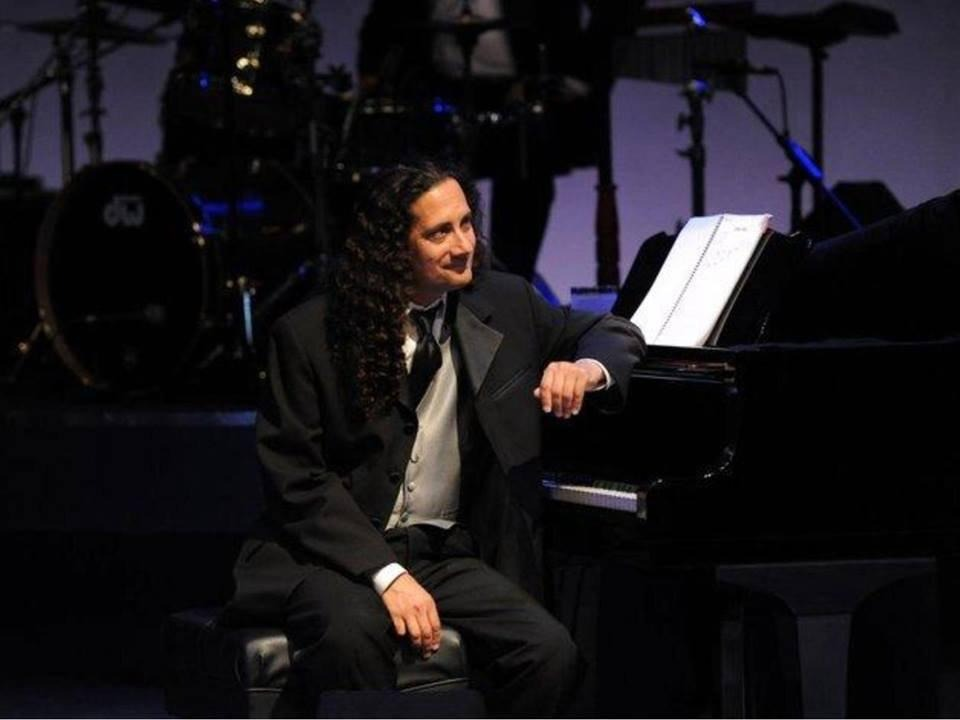
That duality is everywhere in L’Hotel Ritz de Paris. The piece is built as a series of musical portraits, each capturing a character who passed through the hotel’s gilded halls during the war. Some are famous, some obscure, but all are rendered with the same care and curiosity. Vince describes the challenge simply: “How do you say that story? You paint musical portraits.” And so he does through German cabaret, Cuban son, French classical lyricism, tango, and more. The Ritz becomes a stage, and the orchestra becomes its cast.
The stylistic breadth of the piece is staggering, but it is not eclectic for eclecticism’s sake. Vince has spent decades synthesizing genres into a single, coherent musical voice. “These ethnic genres are not imposed or superimposed or combined to make a style,” he explains. “Instead, they are synthesized into a sound that is homogeneous.” His Sicilian heritage, Greek, Spanish, North African, and more lives inside that synthesis. He can inhabit a German cabaret and a Cuban dance club at the same time, and in Ritz, he does exactly that.
The work’s origins trace back to his long collaboration with the Capital Philharmonic of New Jersey, where he serves as Composer in Residence. His earlier opus, Oh God… Beautiful Machine, premiered to critical acclaim, a 90‑minute orchestral work that fused jazz ensemble, women’s chorus, Chinese instrumentalists, and symphonic form. It was a bold statement, and Ritz continues that ambition though in a more narrative, character‑driven way.
The first sketches of Ritz were performed at the Rose Theatre at Lincoln Center with violin soloist Jing Yang. The audience’s reaction told Vince he had found something special. The portraits resonated. The stylistic leaps made sense. The story held. “I knew there and then that I was onto something,” he recalls. The piece rang true.
Part of what makes Ritz so compelling is Vince’s lifelong relationship with storytelling. He spent years as a theatre musical director, shaping productions across North America. Story is in his bones. Rhythm is his entry point. “Usually, the rhythm is the starting point. I need a groove,” he says. From there, ideas arrive “from above,” as he puts it, creation as prayer, composition as listening.
His process is meticulous. He needs order to write: a clean sink, laundry put away, pencils arranged, reference scores within reach. He composes in a studio prepared by his friend Maurice Kurtz, complete with a writing table, coasters, art books, and Rudy the cat, who naps beside him when frustration sets in. “I find composing extremely tiring,” Vince admits. The work demands clarity, discipline, and emotional stamina. But it also demands joy, and Ritz is full of it.
The joy comes from the characters. The Ritz during the 1940s was a crossroads of glamour and danger, a place where artists, spies, aristocrats, refugees, and opportunists brushed shoulders. Vince’s portraits capture that tension: the elegance of a French salon, the pulse of a Cuban rhythm, the shadows of wartime intrigue. Each movement is a room, each room a story.
The joy also comes from the contradictions. Vince thrives on them. He loves the challenge of merging styles that shouldn’t coexist but somehow do. In Ritz, those contradictions become the point. The hotel itself was a contradiction, luxury in a time of fear, beauty in a time of destruction. The music mirrors that complexity.
And beneath it all is Vince’s deep connection to Trenton, the gritty, resilient city that adopted him. “I love being identified with a gritty and hard city,” he says. “A city that thrives in the arts despite incredible challenges.” His work with Passage Theatre, the Capital Philharmonic, Capital Singers, and Artworks has shaped a local artistic ecosystem that punches far above its weight. Ritz is part of that ecosystem, a world‑class symphonic work born in New Jersey’s capital.
The piece also reflects Vince’s evolution. “I am a symphonic composer now,” he says. “Like I dreamt I would be when I was in Paris at 17.” In many ways, Ritz is a return to that dream, a Parisian fantasy reimagined through decades of experience, collaboration, and experimentation. It is the work of a composer who has come full circle, who has embraced both the discipline of classical form and the freedom of jazz improvisation.
The future of the piece, Vince insists, is not his to decide. “Maybe it will have life and maybe it won’t,” he says. “I leave it to providence.” But he has already been paid in full. He has heard his music played by musicians he loves, in a city he believes in, for audiences who feel the story he is telling.
And now, he invites us all inside.
“It’s the 1940s. It’s Paris. The door is open. WELCOME TO THE RITZ!”